



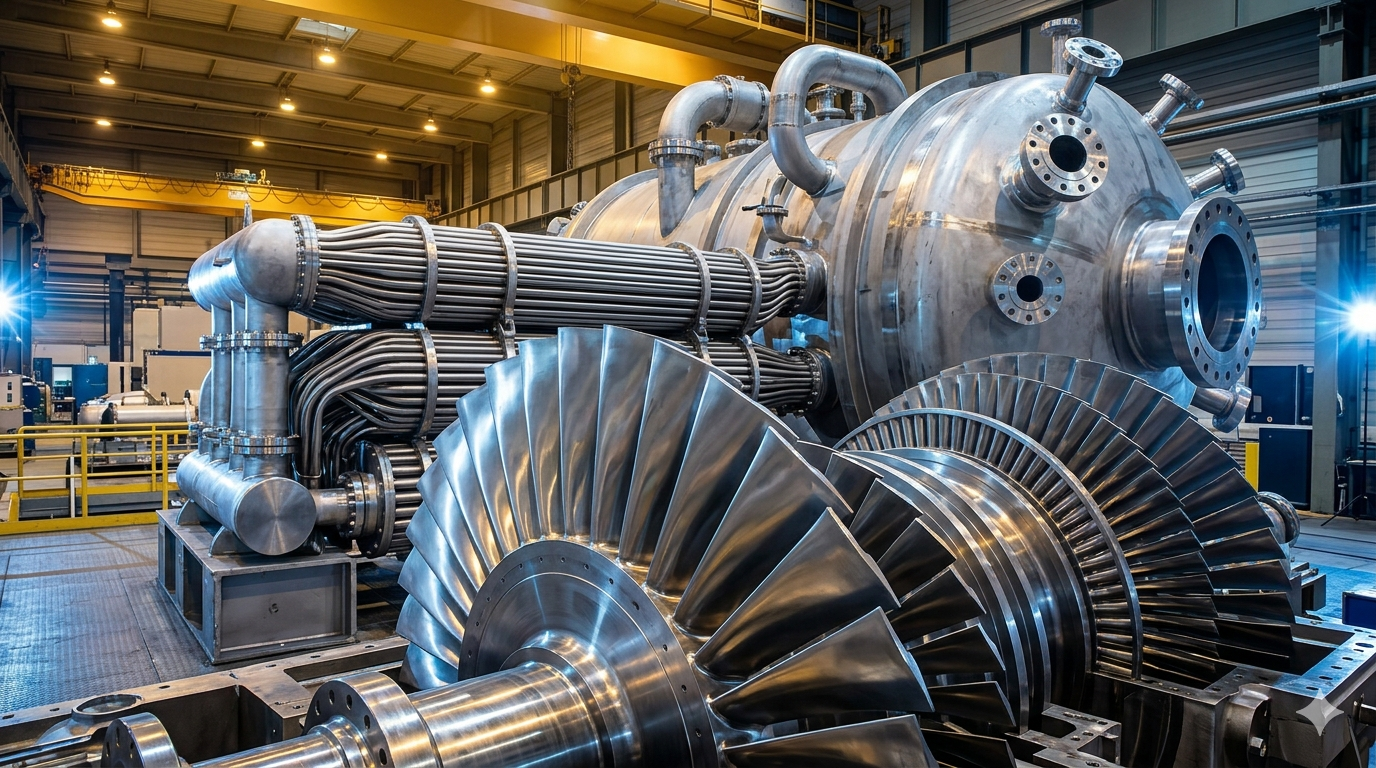
This article provides a comprehensive compendium of knowledge on the use of stainless steel in the automotive industry. We will examine not only the classic solutions known from internal combustion engines but also look under the hoods (and floors) of electric and hydrogen vehicles, where stainless steel is experiencing a renaissance. This analysis, based on current market data and technological trends for 2024 and 2025, will help understand why this noble alloy is indispensable in the era of powertrain transformation.
Understanding the material – what really lies within the alloy?
Before moving on to specific car parts, it is worth reflecting on the very nature of the material. “Stainless steel” is an umbrella term covering a broad family of iron alloys united by one feature: a chromium content of at least 10.5%. It is chromium, reacting with oxygen from the atmosphere, that creates an invisible, passive chromium oxide layer on the metal’s surface. This layer has the ability to self-repair – if the surface is scratched, the oxides immediately rebuild, protecting the material’s core from corrosion.
In automotive applications, random grades are not used. Engineers in Wolfsburg, Turin or Toyota select alloys with surgical precision, balancing cost, strength and thermal resistance. We can distinguish three main groups of stainless steels found in vehicles:
Ferritic Steels (Series 400) – The Workhorses
These are magnetic alloys, containing mainly chromium but little or no expensive nickel.
- Characteristics: Lower cost, good corrosion resistance at high temperatures, low coefficient of thermal expansion (which is crucial when a component repeatedly heats up and cools down).
- Applications: Mainly exhaust systems (mufflers, pipes), decorative interior elements.
- Trivia: The popular grade 409 (1.4512) gradually develops a superficial, rusty patina. However, this is not dangerous deep corrosion but a natural patina. Mechanics often call this material “ugly but eternal”.
Austenitic Steels (Series 300) – Premium Class
This is the aristocracy among steels. Thanks to the addition of nickel (usually 8-10%), the metal’s crystal structure changes.
- Characteristics: Non-magnetic (in the delivered state), excellent corrosion resistance (including chemical), superb formability and impact resistance even at low temperatures.
- Applications: Exhaust systems in luxury and sports cars, fuel system components, clamps, and increasingly – components of hydrogen installations and battery enclosures.
- Challenge: They are significantly more expensive due to nickel market prices, which makes accountants in automotive companies view them with reluctance unless absolutely necessary.
Duplex and Martensitic Steels – Special Tasks
Duplex steels combine features of the two above groups, offering almost twice the mechanical strength. This allows the use of thinner sheets, reducing vehicle weight (so-called lightweighting). Meanwhile, martensitic steels, thanks to their high hardness, find applications for example in motorcycle brake discs or specific sensors.
The exhaust system – the realm of extreme temperatures
Historically, it was the exhaust system that served as the gateway through which stainless steel entered mass automotive production. The demands placed on these components are brutal: cyclic temperature changes from -20°C (cold start in winter) to over 900°C (highway driving), engine vibrations, stone impacts and an aggressive chemical environment – acidic exhaust condensates inside, road salt and mud outside.
From the manifold to the tailpipe – the journey of exhaust gases
- Hot End: The exhaust manifold and turbocharger housing are where temperatures are highest. Here, titanium- or niobium-stabilised ferritic steel (e.g. grade 1.4509 / 441) reigns. It must withstand so-called material creep and not oxidise (not flake) at temperatures close to 950°C.
- Catalytic converters and DPF filters: The catalytic converter housing is a critical element. It must hold the ceramic insert firmly in place despite thermal expansion. Austenitic steels are often used here, as they maintain stiffness at high temperatures.
- Cold End: Mufflers and tailpipes. Here the temperature drops, but the risk of corrosion from water condensates accumulating in the muffler (so-called “cold corrosion”) increases. In mass-market cars, ferritic steel 409 is standard. In the premium segment or tuning, 304 steel is used, which remains silvery and shiny for years.
Digression: The eternal tuner’s dilemma – 409 or 304?
Many car modification enthusiasts face the choice of an “aftermarket” exhaust system. The price difference can be twofold. What is the reason? A system made of 304 (austenitic) steel not only shines. Its main advantage is that it does not suffer from layered corrosion. A 409 steel system after one winter in Polish conditions may look rusty, although technically it will still be leak-tight.
A simple test for buyers: If you place a magnet on the exhaust pipe and it sticks firmly – you are dealing with ferritic steel (409) or ordinary aluminised steel. If the magnet does not stick or attracts very weakly – it is austenitic steel (304), which usually indicates higher quality and durability.
Design, safety and “Lightweighting”
With the tightening of CO2 emission standards, car manufacturers have begun the battle for every kilogram. A lighter car consumes less fuel. However, weight reduction cannot come at the expense of safety. Here, stainless steel enters the realm of structural materials.
Crashworthiness – the art of controlled deformation
Stainless steel possesses a unique metallurgical property: a high capacity for work hardening. What does this mean in practice? During a collision, at the moment the sheet metal begins to deform, its structure becomes harder and more durable. Thanks to this, a component made of stainless steel can absorb significantly more kinetic energy from an impact than a component of the same mass made from ordinary carbon steel.
Therefore, engineers increasingly use stainless steel in so-called Crash Boxes (controlled deformation zones) and bumper beams. This allows for the use of thinner profile walls (weight reduction) while maintaining the same capacity to protect passengers.
Digression: The legend of the DeLorean DMC-12 and Cybertruck
It is impossible to write about stainless steel in the automotive industry without mentioning the pop culture icon – the DeLorean DMC-12. Its body was made from brushed 304 stainless steel, which gave it a futuristic appearance and complete resistance to rust (although maintaining the cleanliness of such a bodywork is a nightmare for every detailer – every fingerprint is visible).
More recently, this topic has returned with Tesla’s Cybertruck, which uses a special cold-rolled stainless steel alloy to build its exoskeleton. This is an example of extreme utilisation of material strength – the body is so hard that it does not require additional reinforcements in the doors, but at the same time poses a challenge for traditional manufacturing methods (stamping), necessitating angular shapes.
The Electric Revolution (BEV) – new challenges
One might think that the move away from combustion engines and the elimination of exhaust systems would be a blow to the stainless steel industry. Nothing could be further from the truth. Electromobility opens entirely new doors.
Battery protection – fighting fire
The heart of an electric car – the lithium-ion battery pack – requires armoured protection. It is not only about impacts from stones underneath but primarily about fire safety. In the event of cell failure and so-called thermal runaway, temperatures can rise rapidly.
Aluminium, popular due to its lightness, melts at around 660°C. Stainless steel maintains structural integrity up to over 1500°C. This difference provides valuable time for passengers to evacuate and for firefighters to carry out extinguishing operations. Therefore, many manufacturers use stainless steel to construct the base and covers of battery enclosures.
Electromagnetic compatibility (EMC)
Electric motors and inverters generate strong electromagnetic fields that can interfere with onboard electronics. Austenitic (non-magnetic) stainless steels are excellent materials for sensor and controller housings because they do not disrupt magnetic fields to the same extent as carbon steel, while simultaneously providing mechanical durability.
Hydrogen – the fuel of the future and a metallurgical challenge
Perhaps the greatest growth potential for stainless steel lies in hydrogen technology (FCEV). Hydrogen is a challenging fuel: its molecules are so small that they can penetrate deep into the metal structure, causing a phenomenon known as hydrogen embrittlement. Ordinary steel under high-pressure hydrogen becomes as brittle as glass and can crack.
Solution: High-nickel austenite
Austenitic steels (e.g., grades 316L or 316LN) are naturally resistant to this phenomenon. Their dense crystal lattice significantly impedes the diffusion of hydrogen atoms. Therefore, in vehicles such as the Toyota Mirai or Hyundai Nexo, as well as throughout the hydrogen refuelling station infrastructure, stainless steel is a mandatory material for:
- Valves and pipes: They must withstand pressures of 700 bars.
- Bipolar plates in fuel cells: These are ultra-thin sheets (approximately 0.1 mm thick) that conduct electricity and separate gases. They must be resistant to the electrochemical corrosion occurring inside the cell.
- Tank components: Although the hydrogen tanks in vehicles are composite (Type 4 – polymer liner wrapped in carbon fibre), all connections, bosses, and fittings (so-called Balance of Plant) are made from high-grade stainless steel.
Market context – Poland and Europe in 2024
Poland is a significant player on the European stainless steel processing map, serving as a production base for many automotive corporations. The year 2024 has brought interesting shifts in the market.
Recovery in the flat products segment
Market data analysis indicates a clear revival in the Polish sector of flat stainless steel products. In 2024, apparent consumption of cold-rolled sheets increased by as much as 20% compared to the previous year. This signals that manufacturing companies (press shops, component producers) are increasing processing capacities in response to growing export demand and the needs of the spare parts market.
|
Product category (Poland 2024) |
Apparent consumption (thousand tonnes) |
Year-on-year dynamics |
|
Cold-rolled sheets |
194.6 |
+20.0% |
|
Cold-rolled strips |
79.8 |
+2.7% |
|
Welded pipes |
52.1 |
-0.8% |
|
Total (flat products) |
330.0 |
+12.0% |
These data show that despite global challenges, the Polish automotive and stainless steel processing sector is performing well. However, it is important to remember that stainless steel prices are strongly correlated with nickel quotations on global exchanges. Fluctuations in the price of this raw material directly translate into production costs of parts, which forces engineers to continuously optimise material usage (e.g., using thinner walls thanks to steels with higher strength).
Manufacturing Techniques – how to shape hard metal?
Stainless steel is hard and elastic, which makes it more difficult to process than ordinary deep-drawing steel. This requires the use of advanced technologies.
Hydroforming (Liquid Forming)
This technology has revolutionised the production of exhaust system components and subframes. Instead of welding a profile from two pressed parts, a stainless steel tube is taken, placed into a mould, and liquid is injected inside under enormous pressure. The tube “inflates”, taking the shape of the mould. Thanks to this, lightweight, rigid components with complex shapes are produced without weld seams, which could be corrosion initiation points.
Welding
Welding stainless steel in the automotive industry (mainly by TIG, MIG, or laser methods) requires gas shielding to prevent oxidation of the weld. A poorly executed weld in the exhaust system is the first place where rust (intergranular corrosion) will appear; therefore, this process is fully robotic and precisely controlled.
Summary
Stainless steel in the automotive industry has come a long way – from simple decorative elements, through mass application in exhaust systems, to key functions in the safety structures of electric and hydrogen vehicles.
Its role in the future seems secure. Although drives are changing, fundamental needs remain the same: the material must be durable, safe, and resistant to extreme conditions. Whether we are talking about a hot manifold in a hybrid, an armoured battery casing in an “electric”, or a hydrogen valve operating at 700 bar pressure – stainless steel is and will remain an indispensable binder of the automotive industry.
For the Polish market, which is a production hub for parts, this means the necessity of continuous adaptation to new steel grades and processing technologies. As data from 2024 show, this sector reacts dynamically to changes, recording double-digit growth in key segments. Stainless steel has not yet said its last word – in fact, in the era of new mobility, it is only beginning to spread its wings.