



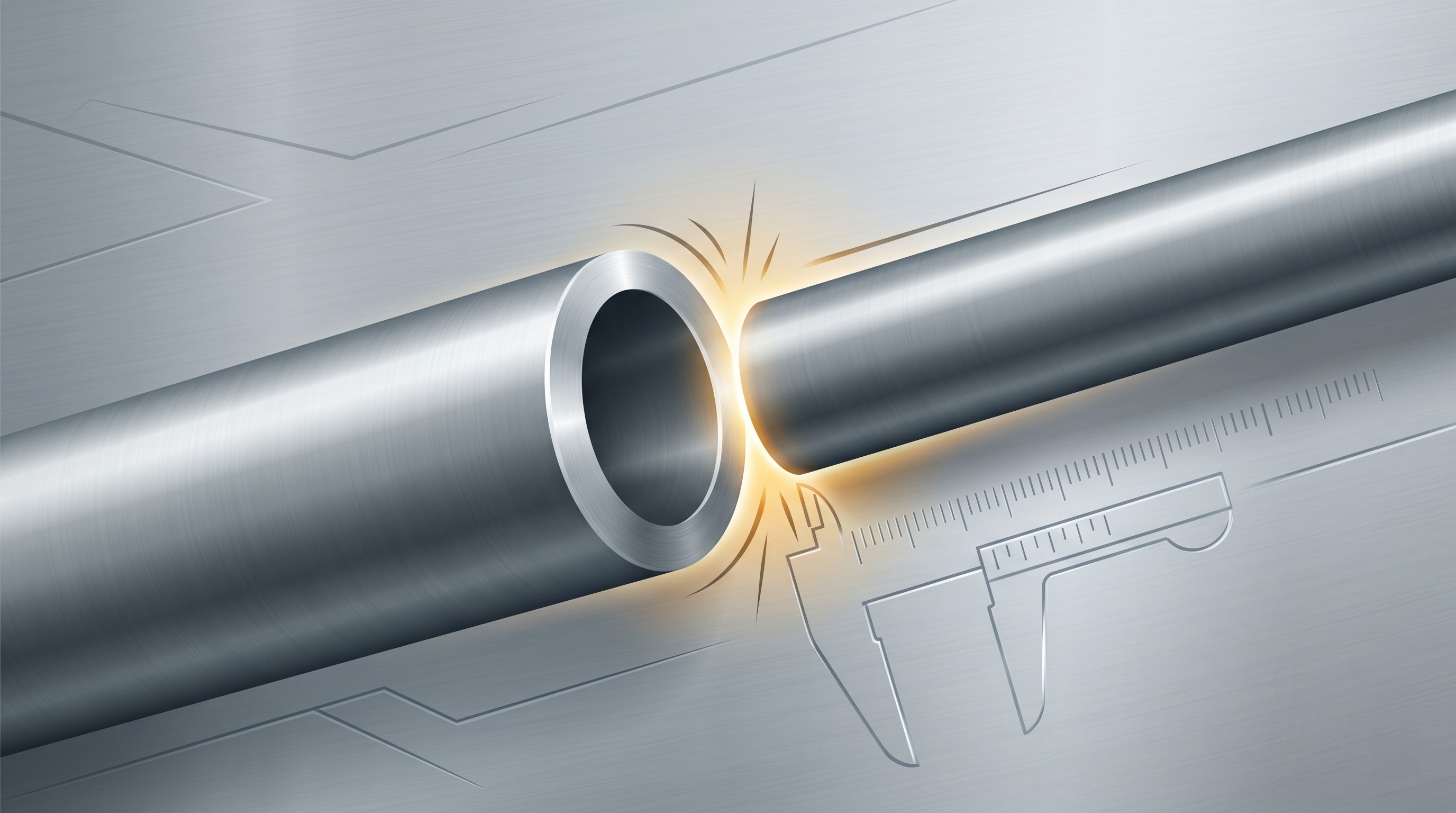
Why your 14mm stainless steel rod won't fit into an 18x2mm pipe
Here is a classic head-scratcher that our customers and sales reps run into more often than you might think. Imagine you are working on a new project and you buy a seamless pipe with a diameter of 18 mm and a 2 mm wall thickness. Naturally, you also pick up a 14 mm stainless steel rod to go with it. You probably assume that one piece will slide right into the other like a hand into a glove, and you can get on with your assembly without any fuss.
On paper, the math is rock solid and perfectly logical. If you take the 18 mm outer diameter and subtract the two 2 mm walls, you get exactly 14 mm. It is basic arithmetic that should work every single time. However, once you get the materials in your workshop, you quickly realize that in practice, it just does not work. The rod stays out, and you are left wondering if someone sent you the wrong size.
The math looks perfect but the steel says no
So, why does this happen? The most important thing to understand is that the internal diameter of a pipe is almost never guaranteed. Pipes are manufactured according to specific standards, such as EN 10216-5, which strictly define the tolerances for the outer diameter and the thickness of the wall. Curiously enough, the internal diameter is not a parameter that the mill actually controls or guarantees during the standard production process.
In the real world, this means your 18 x 2 mm pipe might actually have an internal space of 13.4 mm instead of the expected 14 mm. This is not a mistake or a manufacturing error. Since the product meets the official standards for its outer dimensions and wall thickness, it is considered a perfectly good piece of steel. It is just one of those quirks of the industry that can catch you off guard if you are not prepared for it.
When tolerances stack up against your project
There is a second part to this puzzle, and it involves the rod itself. A 14 mm stainless steel rod does not have to be exactly 14.00 mm. Rods produced under standards like EN 10060 or EN 10278 can often be slightly larger, perhaps sitting somewhere between 14.02 mm and 14.05 mm. While a few hundredths of a millimeter might sound like nothing, in the world of tight fits, it is a massive gap.
What we see here is a classic case of tolerance stacking. In the worst-case scenario, you end up with a pipe that is slightly too small on the inside and a rod that is slightly too large on the outside. When these two factors meet, there is physically no way for the elements to fit together without some serious extra work. It is a bit like trying to put a square peg in a round hole, except both parts are round and they just refuse to cooperate.
You also have to keep in mind that the ovality of a pipe is rarely a perfect circle. Manufacturing standards allow for slight deviations, and when you add in surface roughness or a lack of perfect straightness, the challenge grows. These tiny, sometimes sub-millimeter differences are exactly what makes a simple assembly task turn into a complicated engineering problem.
Is a rod that does not fit actually a defective product?
Many people ask us if this means they have received a faulty product. The short answer is a clear no. It is vital to remember that metallurgical products are made to meet general industry standards, but they are not sold as "ready-to-assemble" matching parts. The fact that a rod will not slide into a pipe is not a valid reason for a technical complaint or a warranty claim.
Think of it this way: the steel mill is providing raw materials, not a finished mechanical kit. The industry standard assumes that if you need two parts to fit together perfectly, you will perform the necessary finishing touches yourself. It is just the way the steel business has operated for decades, from the smallest distributors to the largest smelting plants.
How to order steel elements that actually play nice together
If your project absolutely requires one element to slide into another, you generally have two main paths to follow. The first is mechanical processing. This means you take matters into your own hands by drilling out the pipe to the required size or turning the rod down on a lathe. Both methods work great, but they do require you to have the right tools and a bit of "know-how" in the workshop.
The second option is to move away from "eye-balling" the sizes and start using proper ISO fits. Instead of just picking two sizes that seem to match, you should look for specific fits like H7 / g6. This level of precision is the language of professional engineering. However, you must be aware that these are not usually standard warehouse items that you can just grab off the shelf.
Whenever you find yourself needing that "sure thing" fit where a 14 mm rod definitely goes into a pipe, you should probably look for a pipe with a slightly larger internal diameter from the start. You might still need to do some light sanding or finishing, but it will save you a lot of headaches. Just remember that custom, assembly-ready materials are a different category than the standard stock you find in a regular steel shop.
Can you return or complain about these stainless steel items?
When it comes to returns, things get a bit tricky in the professional world. If the material matches the order and has been cut to a specific length, it is usually considered a non-prefabricated product and cannot be returned. In B2B transactions, the responsibility for choosing the right material for a specific application rests squarely on the buyer.
As long as the steel falls within the tolerances defined by the official norms, it is considered a correct delivery. The lack of a perfect fit between two random pieces of stock does not mean the goods are inconsistent with the contract. This is a standard rule across the entire steel industry, and knowing this can save you time and money on your future builds.
To wrap things up, keep in mind that an 18 x 2 mm pipe and a 14 mm rod are simply not a matched set by default. They are raw materials that require either manual adjustment or very specific tolerance planning. If your next big project relies on parts sliding together, we highly recommend chatting with a designer or a technologist before you hit the "buy" button. A quick consultation can make the difference between a smooth assembly and a pile of steel that just won't fit.