



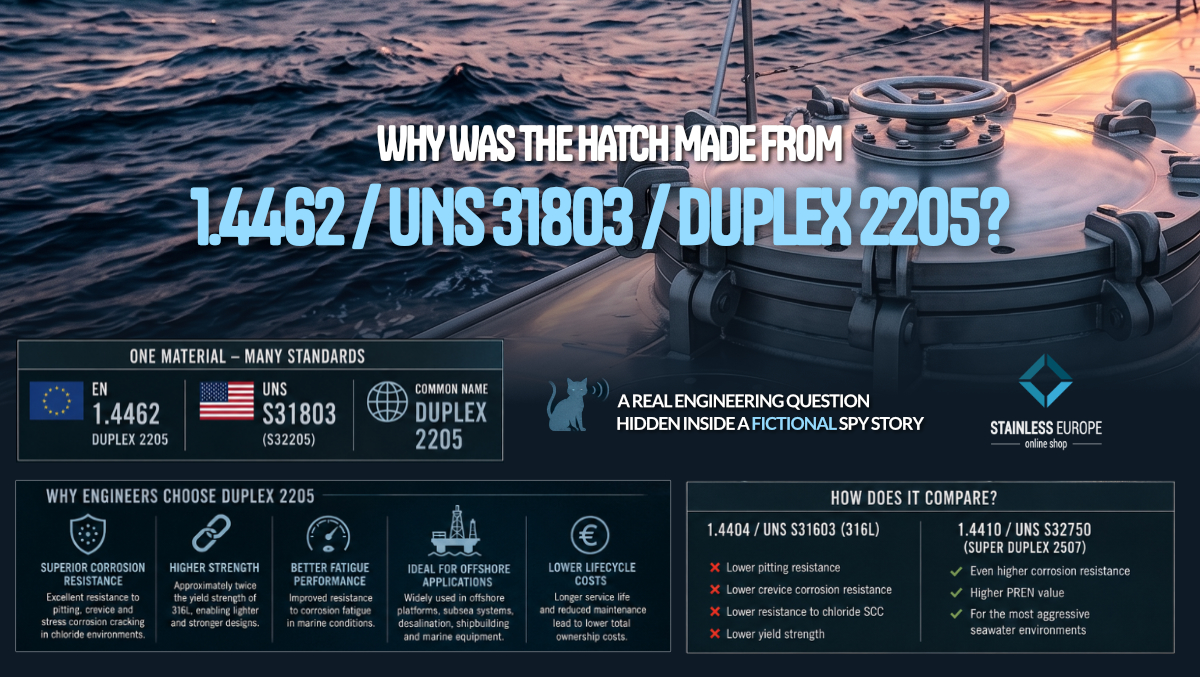
A Real Engineering Question Hidden Inside a Fictional Spy Story
In our recent short film inspired by the Cold War-era Acoustic Kitty project, a fictional intelligence operative escapes through an underwater tunnel concealed beneath a hatch manufactured from 1.4462 / UNS S31803 Duplex 2205 stainless steel.
The espionage story is fictional.
The engineering question is not.
Many viewers have asked why the hatch was described as being manufactured from 1.4462, while others recognised the material under its North American designation UNS S31803 or its commercial name Duplex 2205.
In reality, these names refer to the same family of duplex stainless steels that has become one of the most important engineering materials used in offshore, marine and seawater applications.
Throughout this article we will use both European and North American designations:
-
1.4462 = UNS S31803 / UNS S32205 = Duplex 2205
-
1.4410 = UNS S32750 = Super Duplex 2507
-
1.4404 = UNS S31603 = 316L
-
1.4571 = UNS S31635 = 316Ti
This reflects how engineers, purchasers, fabricators and material suppliers communicate in international projects.
The Real Challenge of Marine Engineering
When most people think about offshore structures, they imagine waves, storms and pressure.
Engineers usually think about something much more dangerous:
chlorides.
Seawater contains approximately 19,000 ppm chloride ions. These ions are capable of attacking many metallic materials through localized corrosion mechanisms that often remain invisible until failure occurs.
The most common threats include:
-
Pitting corrosion
-
Crevice corrosion
-
Chloride stress corrosion cracking
-
Corrosion fatigue
A component can appear perfectly sound while degradation develops beneath the surface.
For offshore operators, shipbuilders and desalination plant owners, material selection becomes one of the most important engineering decisions of the entire project lifecycle.
What Makes Duplex Stainless Steel Different?
Traditional stainless steels such as:
-
1.4301 / 304
-
1.4307 / 304L
-
1.4401 / 316
-
1.4404 / 316L
-
1.4571 / 316Ti
belong primarily to the austenitic family.
Duplex stainless steels are different.
Their microstructure contains approximately equal proportions of:
-
Austenite
-
Ferrite
This dual-phase structure combines the strengths of both metallurgical worlds.
As a result, Duplex 2205 provides:
-
Higher strength
-
Excellent corrosion resistance
-
Improved resistance to chloride attack
-
Good weldability
-
Attractive lifecycle economics
This unique combination explains why Duplex grades have become a preferred choice in marine engineering.
Why Not Use 1.4404 / UNS S31603 (316L)?
This is one of the most common questions asked by engineers and procurement teams.
Grade 1.4404 / UNS S31603 (316L) remains one of the most successful corrosion-resistant materials ever developed.
For thousands of industrial applications, it is an excellent solution.
However, offshore service conditions often push materials beyond the limits of standard austenitic stainless steels.
Compared with 1.4404 / UNS S31603 (316L), Duplex 2205 typically offers:
-
Higher resistance to pitting corrosion
-
Higher resistance to crevice corrosion
-
Superior resistance to chloride stress corrosion cracking
-
Approximately twice the yield strength
-
Better resistance to corrosion fatigue
In practical terms, this means improved reliability and longer service life in seawater environments.
For an underwater hatch exposed to marine conditions over many years, these advantages become highly significant.
Strength Matters as Much as Corrosion Resistance
Corrosion resistance often dominates discussions about stainless steel selection.
However, strength can be equally important.
Duplex 2205 offers approximately double the yield strength of common austenitic stainless steels such as 1.4404 / 316L.
This allows engineers to:
-
Reduce wall thickness
-
Lower component weight
-
Minimize supporting structures
-
Improve structural efficiency
In offshore engineering every kilogram matters.
Weight reductions can influence installation costs, vessel capacity, platform design and overall project economics.
This is one of the reasons Duplex grades have become increasingly popular over the last three decades.
Would Duplex 2205 Be Suitable for a Real Underwater Hatch?
In many cases, yes.
A marine hatch may be exposed to:
-
Continuous seawater contact
-
Salt spray
-
High humidity
-
Oxygen concentration differences
-
Cyclic loading
-
Long maintenance intervals
These conditions closely match the environments for which Duplex 2205 was developed.
Of course, no responsible engineer would select a material based solely on a general description.
Every project requires analysis of:
-
Operating temperature
-
Chloride concentration
-
Design pressure
-
Inspection intervals
-
Expected service life
-
Fabrication methods
Nevertheless, Duplex 2205 would be among the most logical candidate materials for such an application.
When Even Duplex 2205 Is Not Enough
Marine engineering constantly pushes materials to their limits.
In particularly aggressive environments, engineers may select:
1.4410 / UNS S32750 Super Duplex 2507
Compared with Duplex 2205, Super Duplex 2507 offers:
-
Higher PREN values
-
Greater pitting resistance
-
Improved crevice corrosion resistance
-
Increased safety margins in highly chlorinated environments
For this reason, 1.4410 / UNS S32750 is commonly used in:
-
Seawater injection systems
-
Offshore oil and gas platforms
-
Subsea infrastructure
-
Desalination plants
-
Marine processing systems
When failure is simply not an option, Super Duplex frequently becomes the preferred solution.
Why Duplex and Super Duplex Are So Important Offshore
Today, Duplex and Super Duplex stainless steels can be found throughout:
-
Offshore oil and gas production
-
FPSOs
-
Shipbuilding
-
LNG terminals
-
Desalination facilities
-
Chemical plants
-
Seawater cooling systems
-
Heat exchangers
-
Pressure vessels
-
Marine piping networks
In many of these applications, the correct material choice determines whether equipment survives for decades or requires costly replacement after only a few years.
The consequences of material failure offshore can be measured not only in money, but also in environmental impact and operational safety.
From Acoustic Kitty to Offshore Engineering
The inspiration for our film came from one of the most unusual intelligence projects of the Cold War: Acoustic Kitty.
The inspiration for the hatch came from real engineering practice.
Every day, engineers around the world make decisions about material selection that influence the reliability of offshore facilities, vessels and industrial installations for decades to come.
The fictional intelligence operative in the film escapes through a hatch manufactured from 1.4462 / UNS S31803 Duplex 2205.
The character may be fictional.
The material is very real.
And in offshore engineering, selecting the right material is often far more important than selecting the right spy.
References
-
EN 10088 – Stainless Steels.
-
International Molybdenum Association (IMOA), Practical Guidelines for the Fabrication of Duplex Stainless Steels.
-
ASM Handbook, Volume 13A – Corrosion: Fundamentals, Testing and Protection.
-
NACE International, Corrosion in Marine Environments.
-
ISO 21457 – Materials Selection and Corrosion Control for Oil and Gas Production Systems.
-
CIA Historical Review Program – Acoustic Kitty Project.
-
Sedriks, A.J., Corrosion of Stainless Steels, Wiley-Interscience.
Enjoyed the Film?
The story may be fictional, but the engineering challenges are real.
If you enjoy content that combines engineering, metallurgy, industrial history and real-world applications of stainless steels and special alloys, follow Stainless Europe on social media.
We regularly publish articles, technical insights and short films inspired by real engineering challenges from industries such as:
-
Offshore
-
Shipbuilding
-
Energy
-
Chemical Processing
-
Aerospace
-
Advanced Manufacturing
Follow us for more stories where engineering meets history.
Instagram: @stainlesseurope
Facebook: Stainless Europe
YouTube: Stainless Europe
Because sometimes the most interesting engineering stories begin with a seemingly simple question:
"Why was that made from this particular material?"