



Dimensions of seamless stainless steel elbows to EN 10253-4/A in three designs: 90° type 3D, 90° type 2D (r ≈ 1.0 × inner diameter) and 45° type 3D. Symbols: D - outside diameter, s - wall thickness, r - bending radius (mm). Expand the table for the selected elbow type to see all available size combinations.
How to use the dimension tables
This page lists the dimensions of seamless stainless steel elbows manufactured to EN 10253-4/A, in three designs: 90° elbows with a 3D radius (from 12 to 168.3 mm), 90° elbows with a 2D radius (from 21.3 to 273 mm) and 45° elbows with a 3D radius (from 12 to 323.9 mm). Each row is one available combination: outside diameter D, wall thickness s and bending radius r; the 45° elbow table additionally gives the dimensional tolerance.
When selecting an elbow for your installation, match D and s to the pipe it will be butt-welded to - the outside diameter and wall thickness of the fitting should correspond to the pipe dimensions so that the weld face is even and the flow undisturbed.
Type 2D or 3D - which radius to choose
The type designation refers to the elbow's bending radius. In 2D elbows the bending radius roughly corresponds to the inner diameter of the pipe (r ≈ 1.0×d) - the bend is tight and the elbow compact, which makes it easier to fit in confined spaces. 3D elbows have a distinctly larger radius - the change of flow direction is gentler, which translates into lower hydraulic resistance, less turbulence and slower wall erosion at the bend.
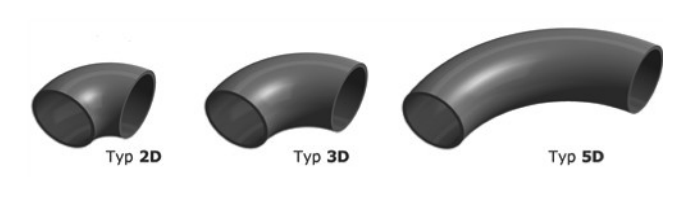
In practice: where space matters - 2D; where flow, abrasive media, high velocities or mechanical pipeline cleaning (pigging) matter - 3D. 45° elbows are used for gentle changes of routing direction; two 45° elbows joined together give a 90° change of direction with a longer, gentler arc than a single 90° elbow.
EN 10253-4 - butt-welding elbows
The EN 10253-4 standard covers butt-welding pipe fittings made of austenitic and austenitic-ferritic (duplex) stainless steels. It specifies dimensions, manufacturing tolerances, material requirements and testing. The elbows in the tables are made to type A of this standard (reduced utilisation factor - in pressure calculations a type A elbow is treated conservatively). The fittings are supplied with a 3.1 inspection certificate to EN 10204 and meet the requirements of, among others, AD 2000 W2/W10 as well as HP 7/3 and HP 8/3.
Seamless fittings - formed from seamless pipe - have no longitudinal weld, and therefore no weakened zone at a joint. The standard catalogue grades are the stabilised austenitic steels 1.4541 (321) and 1.4571 (316Ti); 1.4462 (duplex), 1.4539 and 1.4841 are also available on request. Detailed grade availability for individual sizes can be found on the product pages in the shop.
Manufacturing tolerances to EN 10253-4
90° elbows (type 2D and 3D)
| Wymiar | Tolerancja |
|---|---|
| [D] Outside diameter | ± 1.0% or ± 0.5 mm* (EN tolerance class D2) |
| [r] Bending radius | D ≤ 219.1 mm: ± 2.0 mm; D ≤ 762 mm: ± 5.0 mm |
| [T] Wall thickness | −12.5% / +15% |
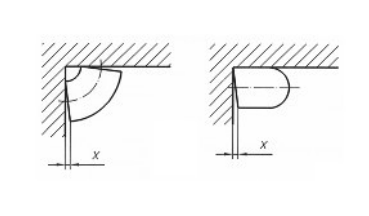
| [X] Squareness, alignment | 1% of the outside diameter or 1 mm* |
45° elbows
| Wymiar | Tolerancja |
|---|---|
| [D] Outside diameter | ± 1.0% or ± 0.5 mm* (EN tolerance class D2) |
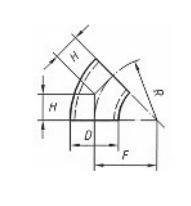
| [r] Bending radius | D ≤ 219.1 mm: ± 3.0 mm; D ≤ 762 mm: ± 5.0 mm |
| [H] Centre-to-end dimension | D ≤ 219.1 mm: ± 2.0 mm; D ≤ 762 mm: ± 5.0 mm |
| [T] Wall thickness | −12.5% / +15% |
| [X] Squareness, alignment | 1% of the outside diameter or 1 mm* |
* whichever is greater
Frequently asked questions
What is the difference between a 2D and a 3D elbow?
The difference is the bending radius: in a 2D elbow the bending radius roughly corresponds to the inner diameter of the pipe (r ≈ 1.0×d), while in a 3D elbow it is distinctly larger. A 2D elbow is more compact and takes up less installation space; a 3D elbow gives a gentler change of direction - lower flow resistance, less turbulence and slower wall erosion at the bend.
When are 45° elbows used instead of 90°?
45° elbows are used for gentle changes of routing direction - e.g. when bypassing obstacles, running a pipeline at an angle, or wherever a full right angle would needlessly increase resistance. Two 45° elbows joined together give a 90° change of direction with a longer, gentler arc than a single 90° elbow - a solution readily used in high-flow installations.
How do I match an elbow to a pipe?
Match the elbow's outside diameter D and wall thickness s to the pipe it will be welded to. In butt welding, both parts must have matching dimensions at the joint - a difference in wall thickness makes a sound weld harder to achieve and disturbs the flow. If your pipe is 48.3 × 3.2 mm, choose a 48.3 × 3.2 mm elbow in the required radius type.
What do the columns D, s and r in the tables mean?
D is the outside diameter of the elbow (identical to the pipe diameter), s is the wall thickness, and r is the bending radius measured to the elbow axis. In the 45° elbow table, the tolerance r column additionally gives the dimensional tolerance for the given diameter. All dimensions are in millimetres.
Why seamless elbows rather than welded?
A seamless elbow is formed from seamless pipe and has no longitudinal weld - i.e. no zone of potentially reduced strength and corrosion resistance. In pressure installations and aggressive media, the absence of a weld means lower risk: there is no heat-affected zone and no potential joint defects on the bend, where stresses are highest.
Are the elbows available in grade 316L?
The standard catalogue grades are 1.4541 (321) and 1.4571 (316Ti) - a titanium-stabilised variant of 316 with corrosion resistance close to 1.4404. 1.4462 (duplex), 1.4539 and 1.4841 are also available on request. Availability of a specific grade for a given size can be checked on the product page in the shop; for larger quantities, made-to-order production is also possible.